Gyeongju: A guide to Korea's ancient Silla capital
Gyeongju was Silla's capital for nearly 1,000 years. A practical guide to its UNESCO temples, royal tombs, night views, and how to visit by KTX.
By Jae Park · Updated Jul 20, 2026
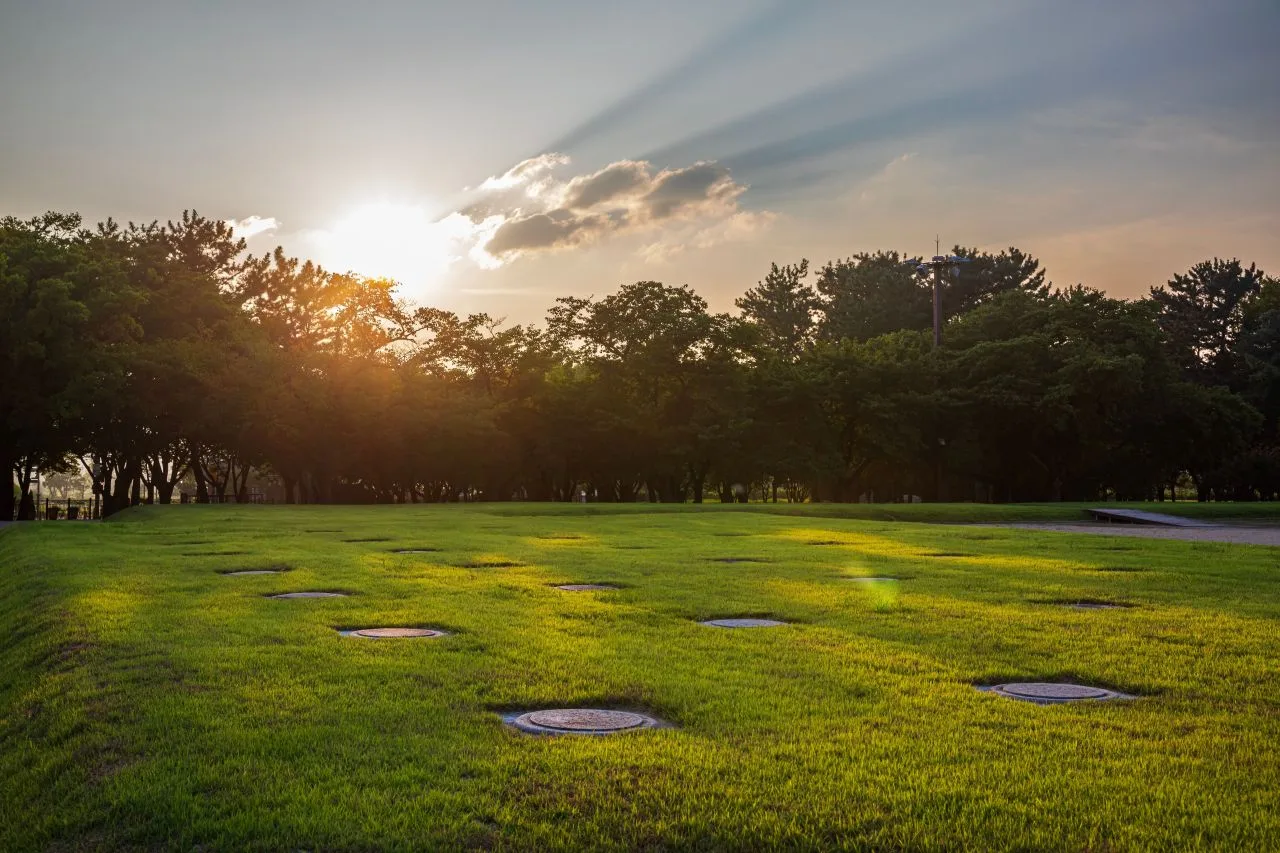
Walk through the center of Gyeongju and you pass grass-covered hills that turn out not to be hills at all. They are royal tombs, some taller than a four-story building, rising between the streets and the coffee shops as if the modern city were laid out around them. It was. Gyeongju served as the capital of Silla for nearly a thousand years, and the kingdom left its dead, its temples, and its palaces scattered across an area you can cover on foot or by bike. People call the whole place an open-air museum, a museum without walls, and once you spot a burial mound sitting across the road from a convenience store, the phrase makes plain sense.
Silla in brief
Silla began around 57 BCE as one of Korea's Three Kingdoms and grew from a small state in the southeast into the power that unified most of the peninsula. By 668 CE it had absorbed its rivals Baekje and Goguryeo, ruling a unified Korea until the dynasty finally fell in 935 CE. (worldhistory.org) Through all of it the capital stayed in one place: Gyeongju, then called Seorabeol. Buddhism became the state religion in the 6th century and shaped nearly everything the court built, from grotto shrines to soaring temple pagodas.
That long run matters for a visitor. Most of the Korean history that tourists meet in Seoul belongs to the later Joseon dynasty, which came centuries afterward and left the palaces and Confucian academies you see up north. If you want to know how that chapter fits, our Joseon dynasty in 10 minutes guide lays it out. Silla is older, and its flavor is Buddhist and aristocratic rather than Confucian. Gold crowns, stone pagodas, and grand earthen tombs came out of a court that traded along Silk Road routes and sent monks to China and India. Gyeongju is where almost all of it survives, which is why UNESCO lists both individual monuments here and the wider Gyeongju Historic Areas, inscribed in 2000.
Bulguksa Temple and Seokguram Grotto
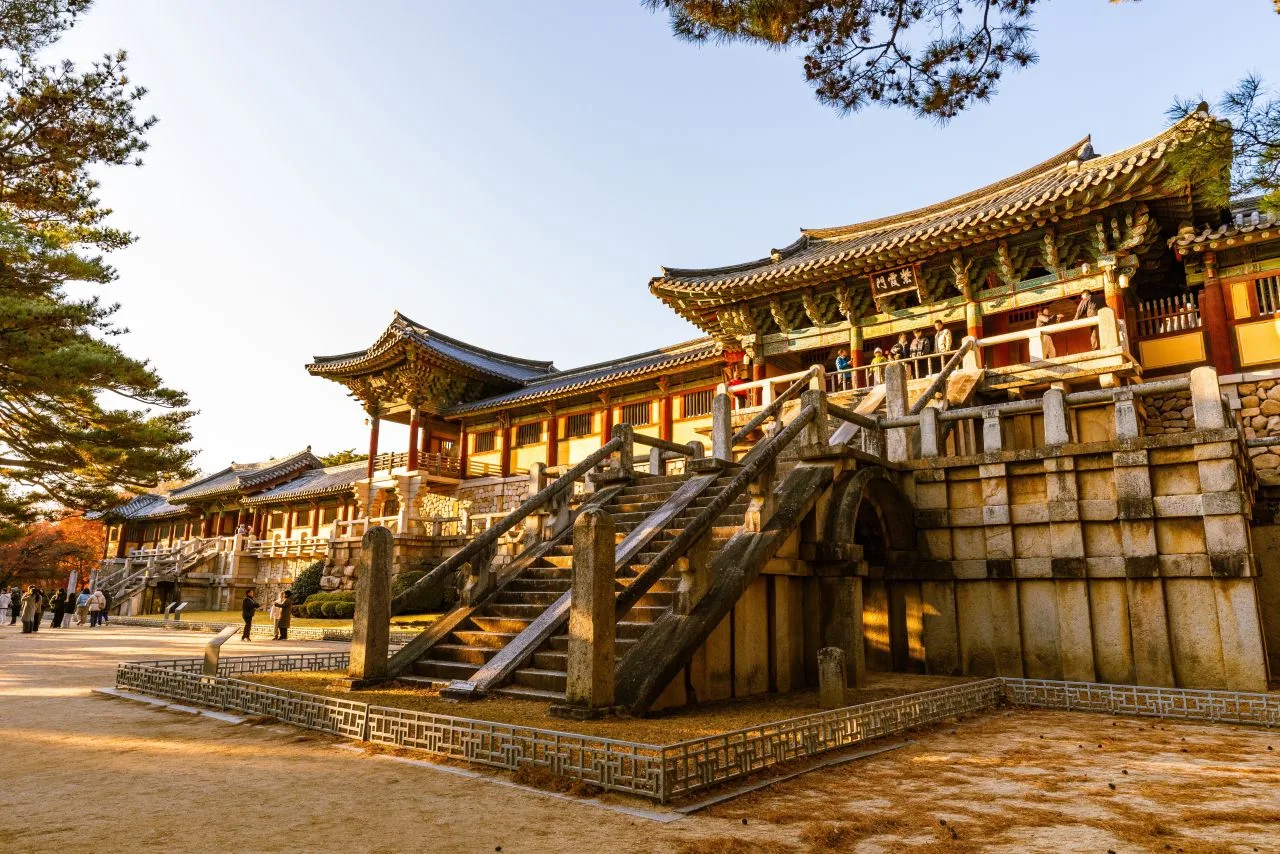
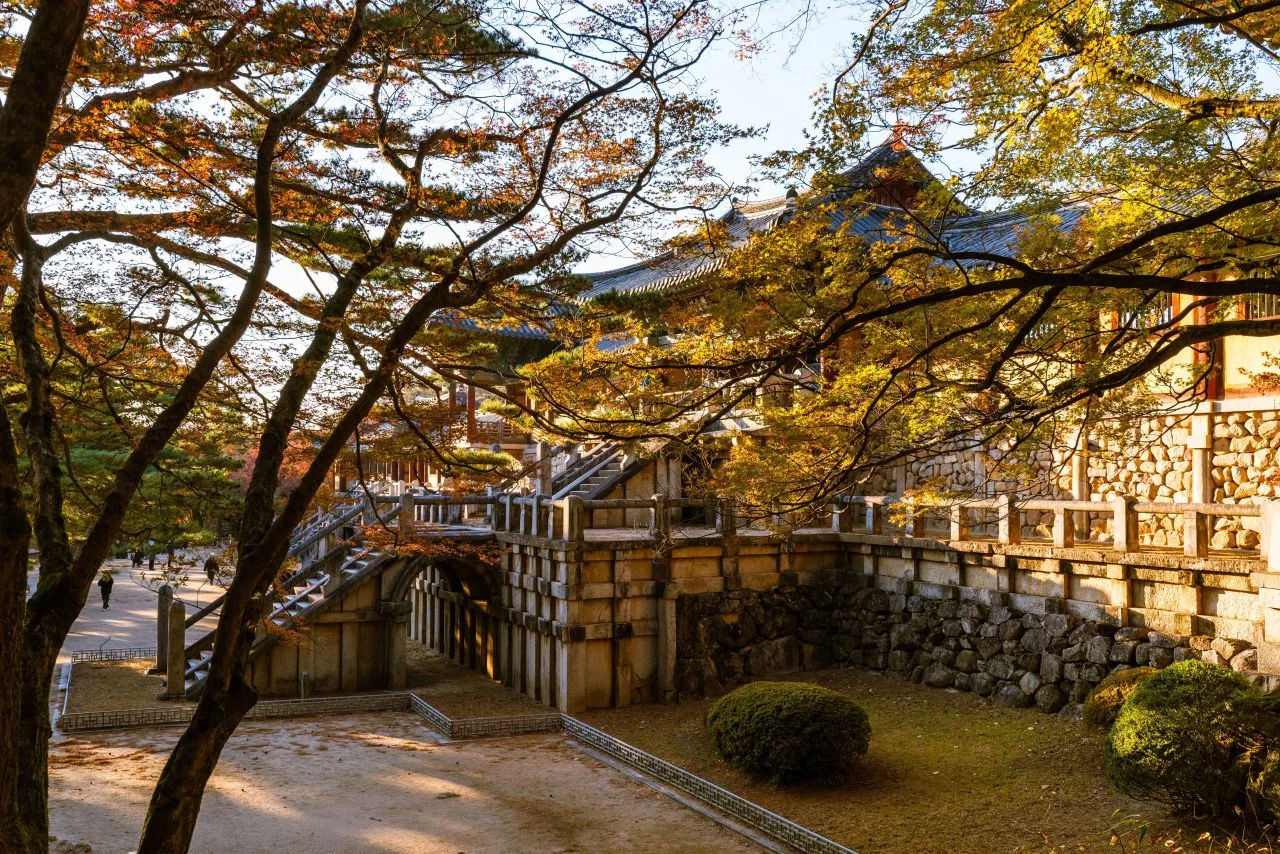
Two sites on the slopes of Mount Toham earned Gyeongju its first UNESCO listing, added together in 1995. (whc.unesco.org) Bulguksa, the Temple of the Buddha Land, was built in stone and wood in the 8th century, with a traditional start date of 751 CE. Its terraces, twin pagodas, and bridge-shaped staircases were laid out with a precision that still reads as deliberate rather than decorative. The two stone pagodas in the main courtyard, Dabotap and Seokgatap, are among the most reproduced images in Korean art, and Dabotap appears on the back of the 10-won coin. One of the world's oldest surviving printed texts, a Buddhist dharani scroll, was found tucked inside Seokgatap.
A short drive higher up the mountain sits Seokguram, a man-made granite grotto sheltering a seated Buddha that faces the East Sea. The figure was carved and assembled in the 8th century using a geometry that aligns the statue with the sunrise. Today you view it through glass that protects the interior climate, so temper expectations. You look in rather than walk around it, and photography of the Buddha is restricted.
Give the pair half a day. They sit outside the downtown cluster, so plan the trip as its own leg. For the bigger picture of what else carries this status in the country, see our roundup of Korea's UNESCO World Heritage sites.
The royal tombs and Cheonmachong
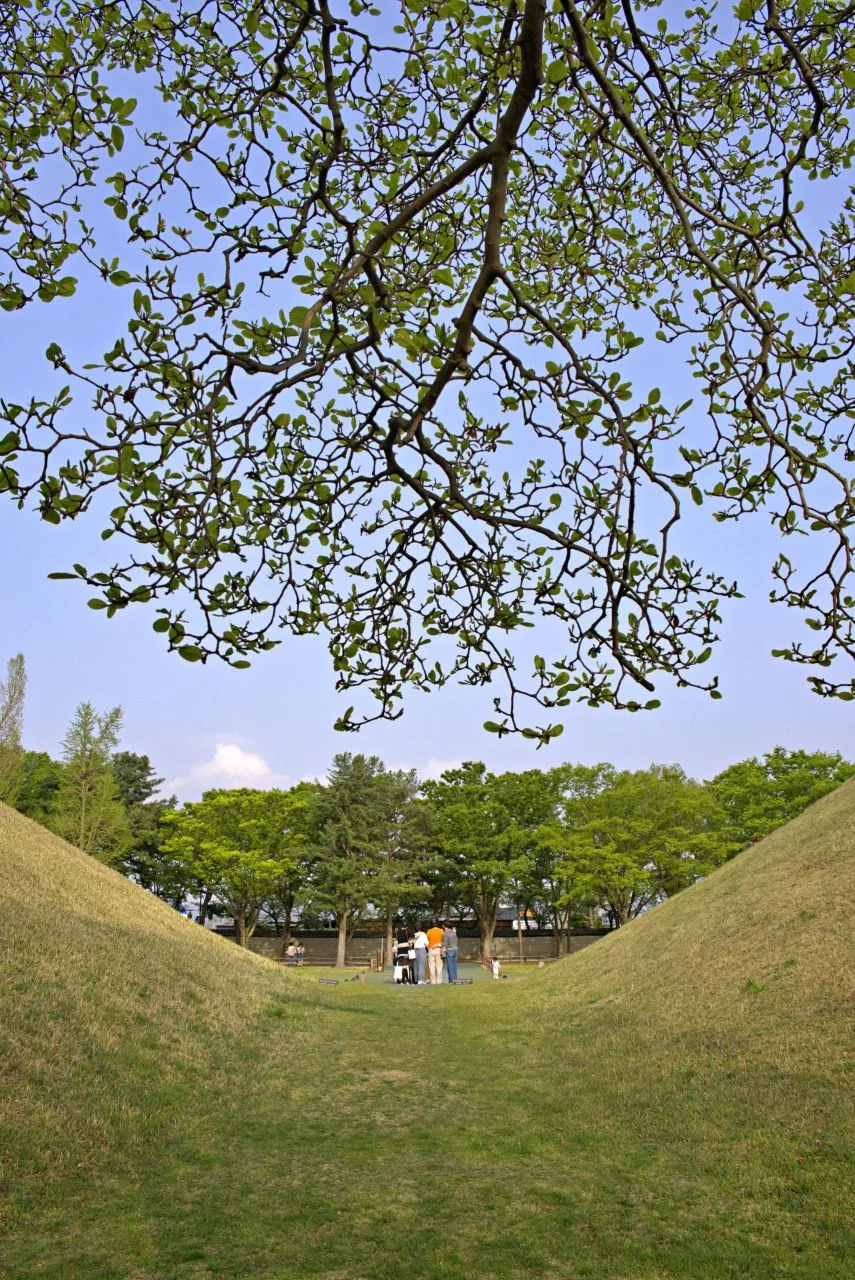
Back in the city, the Daereungwon complex gathers 23 large tombs of Silla kings, queens, and nobles under mounded earth. (en.wikipedia.org) You walk a landscaped path between them, and in spring a lone magnolia and a much-photographed pair of trees frame the mounds against the sky.
One tomb here is open to walk into: Cheonmachong, the Heavenly Horse Tomb. Excavated in 1973, it dates to roughly the 5th or 6th century and gave up more than ten thousand artifacts, including a gold crown and a gold belt. (en.wikipedia.org) Its name comes from a painting of a white horse with wings at its feet, found on a birch-bark saddle flap. That original is far too fragile to display in the open, but the tomb interior shows a reconstruction and explains how Silla built these mounds. Workers set a wooden chamber on the ground, piled river stones over it, then heaped earth on top. That stone layer is why grave robbers never got in, and why so much gold survived to be dug up in the 20th century.
Wandering the park among the mounds is a gentle way to spend an hour, and entering the Cheonmachong interior sits behind a modest ticket. Go early, before the tour groups arrive, and the field feels like what it is, a quiet meadow full of kings.
Cheomseongdae, the stargazing tower
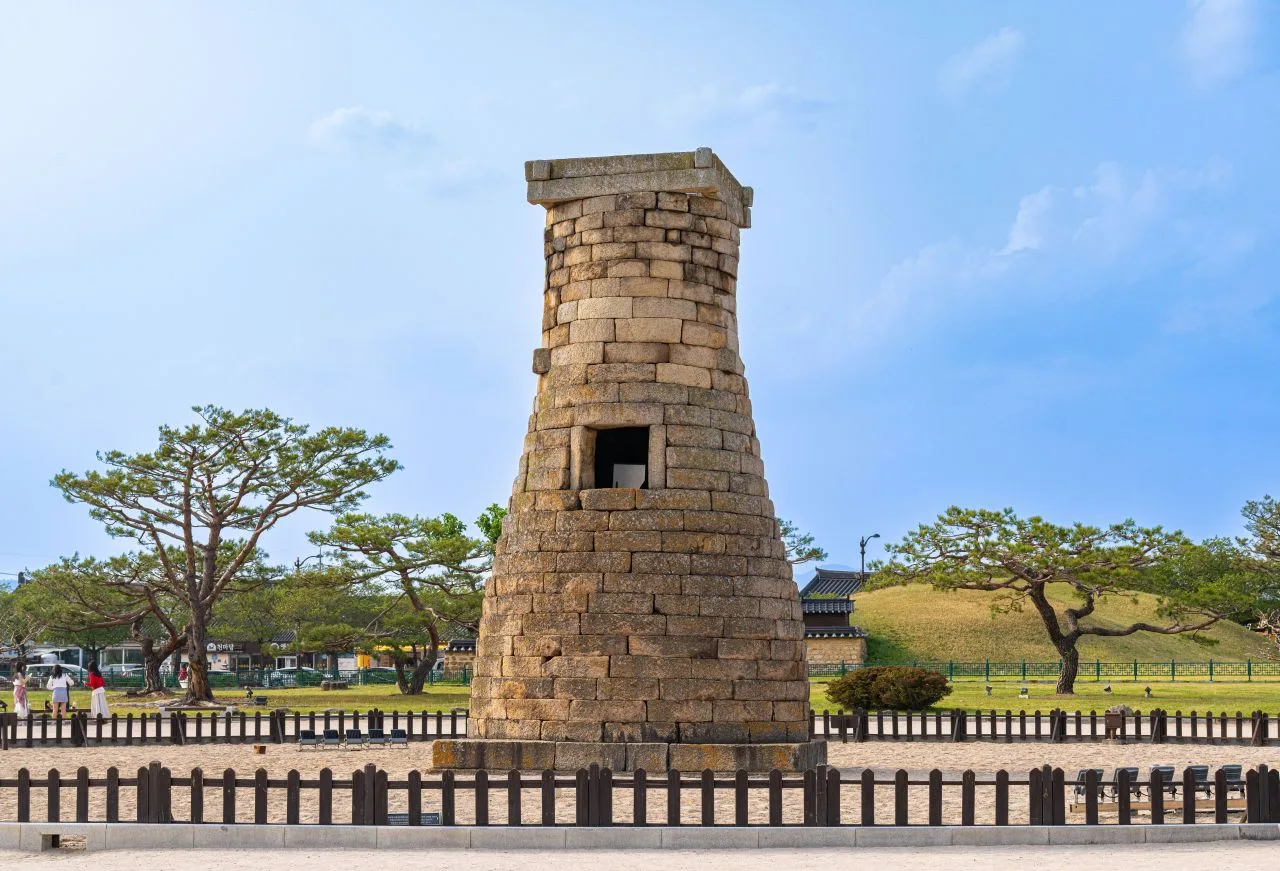
A few minutes' walk from the tombs stands a curious bottle-shaped tower of cut granite, about nine meters tall. This is Cheomseongdae, built in the 7th century during the reign of Queen Seondeok, and it is often described as the oldest surviving astronomical observatory in East Asia. (worldhistory.org)
It rewards a little context, because from the outside it is simply a tidy stone cylinder. The details are the point. Scholars count 27 courses of stone, which matches Seondeok as Silla's 27th ruler, and roughly 362 stones, close to the number of days in a lunar year. A square window halfway up may have been the access point for observers. Whether court astronomers actually climbed inside to track the stars or used the tower more ceremonially is still debated, which is honest to say rather than pretend certainty.
You cannot go in or climb up, so a visit is short. It works best combined with the tombs and the palace pond, all within an easy stroll across the flat historic core. Come back after dark too, when the tower is lit and the daytime crowds have thinned. The surrounding fields are planted with flowers in season, and photographers line the paths here at sunset.
Donggung Palace and Wolji Pond after dark
If you do one thing in Gyeongju in the evening, make it this. Donggung Palace and Wolji Pond was a secondary palace and pleasure garden of the Silla court, built by order of King Munmu in 674 CE. (en.wikipedia.org) The pond's name means moon-reflecting pond, and the whole design was meant to be read from the water's edge, with pavilions doubled on the still surface.
Older signs and guidebooks call the site Anapji, a name coined later, so do not be thrown if your map app shows both. The reconstructed halls stand on excavated foundations, and archaeologists pulled tens of thousands of relics from the pond mud, many now displayed in the national museum.
The reason to come at night is straightforward. Floodlights turn the pavilions and their reflections into the postcard image of Gyeongju, and the site stays open into the evening, roughly until 10 p.m., though you should confirm current hours before heading over. Silla did not build throne halls on the scale of the grand palaces you find in the capital today. If you want that comparison, our guide to Seoul's five grand palaces covers the later Joseon style. Here the scale is smaller and the whole mood is water and lamplight.
Gyeongju National Museum
To tie the scattered ruins together, spend a couple of hours at the Gyeongju National Museum. Most of the gold that came out of the tombs lives here, including Silla crowns, belts, and jewelry worked in thin sheet gold and jade. (koreatimes.co.kr) Seeing a crown up close, then standing in front of the very mound it came from, is the moment Silla stops being abstract.
The museum's outdoor collection is worth the walk, and its most famous single object hangs there: the Divine Bell of King Seongdeok, a bronze bell more than three meters tall cast in the 8th century, known in folklore as the Emille Bell. Galleries inside cover Buddhist sculpture, roof tiles, and finds pulled from Wolji Pond, so a museum visit pairs neatly with the pond itself.
Admission to the permanent galleries is generally free, though special exhibitions may charge and the museum closes one day a week, so check the schedule before you go. English labeling is good by Korean museum standards. If you are traveling with children or short on time, this is the single stop that turns a field of grass mounds into a story you can follow. Budget more time than you expect, since the grounds are large and the gold cases reward slow looking.
Getting there and getting around
Gyeongju sits in the southeast, and the fast way in is the KTX high-speed train. Trains from Seoul reach the city's KTX stop, Gyeongju Station, which opened as and is still often signed as Singyeongju, in about two hours. (en.wikipedia.org) From Busan the ride runs well under an hour, which makes Gyeongju an easy add-on to a southern trip. Most international visitors arrive at Incheon, so our Incheon Airport to Seoul guide covers that first leg, and you connect to the KTX from Seoul Station.
The KTX station sits outside town, so a bus or taxi bridges the last stretch to the historic center. Downtown, the good news is that the main cluster is compact. Cheomseongdae, Daereungwon, Wolji Pond, and Woljeonggyo Bridge all lie within walking distance of one another, and renting a bike is a popular way to loop them. Bulguksa, Seokguram, and the museum sit farther out and need a bus, a taxi, or a tour — you can book a Gyeongju day tour on Klook if you would rather not work out the bus routes.
This guide contains affiliate links. If you book through them we may earn a small commission, at no extra cost to you.
A rechargeable transit card makes the local buses painless and works nationwide, so read our Korea travel card explainer before you arrive. Download KakaoMap as well, since Google Maps gives limited transit routing inside Korea, and Kakao shows the right bus numbers and stops.
When to go and where to eat
Two seasons stand out. Early to mid-April brings cherry blossoms, and Gyeongju ranks among the country's best places to see them, with petals drifting over the tomb mounds and along the reservoir road. Late October into early November turns the maples and ginkgoes around Bulguksa gold and red, the other photographer's season. Summer is hot and humid, winter is cold but calm, and both work if you dress for the weather.
For food and a break, aim for Woljeonggyo Bridge and Hwangnidan-gil. Woljeonggyo is a reconstructed Silla-era covered wooden bridge, handsome by day and lit at night, and it sits a short walk from the palace pond. Hwangnidan-gil, in the old Hwangnam neighborhood, is a lane of renovated hanok houses turned into cafes, dessert shops, and small restaurants. It is where locals and visitors slow down between sites, and it gets busy on weekend afternoons.
Try the city's signature Gyeongju bread, a small red-bean pastry sold fresh near the tombs, and ssambap, a spread of rice, vegetables, and leaves for wrapping that this area is known for. Two full days let you cover the walkable downtown cluster on day one and Bulguksa, Seokguram, and the museum on day two, without feeling rushed at any single stop.
Before you go
Gyeongju rewards a slower pace than a single day allows. Give it two nights if you can, compare Gyeongju hotels on Agoda before you book, and keep the evenings for Wolji Pond and Woljeonggyo, and use at least one museum visit to connect the gold to the graves it came from. Check current opening hours and any admission fees on official pages before you set out, since seasonal schedules shift. Come for the tombs, and you leave with a real feel for a kingdom that ran Korea for a thousand years.
Location
Gyeongju, South Korea
View on Google MapsFrequently asked questions
How do I get to Gyeongju from Seoul?
Take a KTX high-speed train from Seoul Station to Gyeongju Station (which opened as and is still often signed as Singyeongju). The ride takes about two hours, and from the station a local bus or taxi reaches the historic center.
How many days do you need in Gyeongju?
Two full days is comfortable. Spend one on the walkable downtown cluster of tombs, Cheomseongdae, and Wolji Pond, and one on Bulguksa, Seokguram, and the national museum, which sit farther out of town.
Are Bulguksa and Seokguram UNESCO World Heritage sites?
Yes. Bulguksa Temple and Seokguram Grotto were jointly inscribed on the UNESCO World Heritage List in 1995, and the wider Gyeongju Historic Areas were added in 2000.
When is the best time to visit Gyeongju?
Early to mid-April for cherry blossoms and late October to early November for autumn foliage are the two standout windows. Both draw crowds, so book accommodation ahead.
Why is Gyeongju called a museum without walls?
Because Silla-era tombs, temples, and monuments sit throughout the modern city, often right beside ordinary streets and shops, so the whole city functions as an open-air museum.
Sources
This guide was researched using the references below. Prices and times change, so confirm anything time-sensitive on the official page before you rely on it.
Related guides
- Exploring Seoul's Buddhist temples: a guide for visitorsDiscover Seoul's Buddhist temples, from the central Jogyesa to the serene Bongeunsa, and learn about their history, architecture, and visitor experiences.
- Exploring Seoul's royal palaces: a guide for visitorsDiscover Seoul's five grand palaces, their unique features, and practical tips for your visit.
- Korean folk villages worth visitingExplore Korea's rich history by visiting these traditional folk villages, each offering unique insights into the country's cultural heritage.
- Visiting the Korean DMZ: A 2026 Guide for Foreign TravelersHow to visit the Korean DMZ from Seoul in 2026: guided tours only, passport rules, the main sites, and why JSA access at Panmunjom keeps changing.
- UNESCO World Heritage Sites you can visit in KoreaA first-person guide to Korea's UNESCO World Heritage sites, with real hours, won prices, and directions to Bulguksa, Changdeokgung and Jeju.
- Seoul's five grand palaces, explainedA first-person guide to Seoul's five grand Joseon palaces: real 2026 prices, hours, subway exits, the hanbok free-entry hack, and how to see them without burning out.