An introduction to Korean traditional dance for visitors
A clear guide to Korean traditional dance for foreigners: court and folk forms, buchaechum, talchum, salpuri, seungmu, and where to watch them live.
By Jae Park · Updated Jul 20, 2026
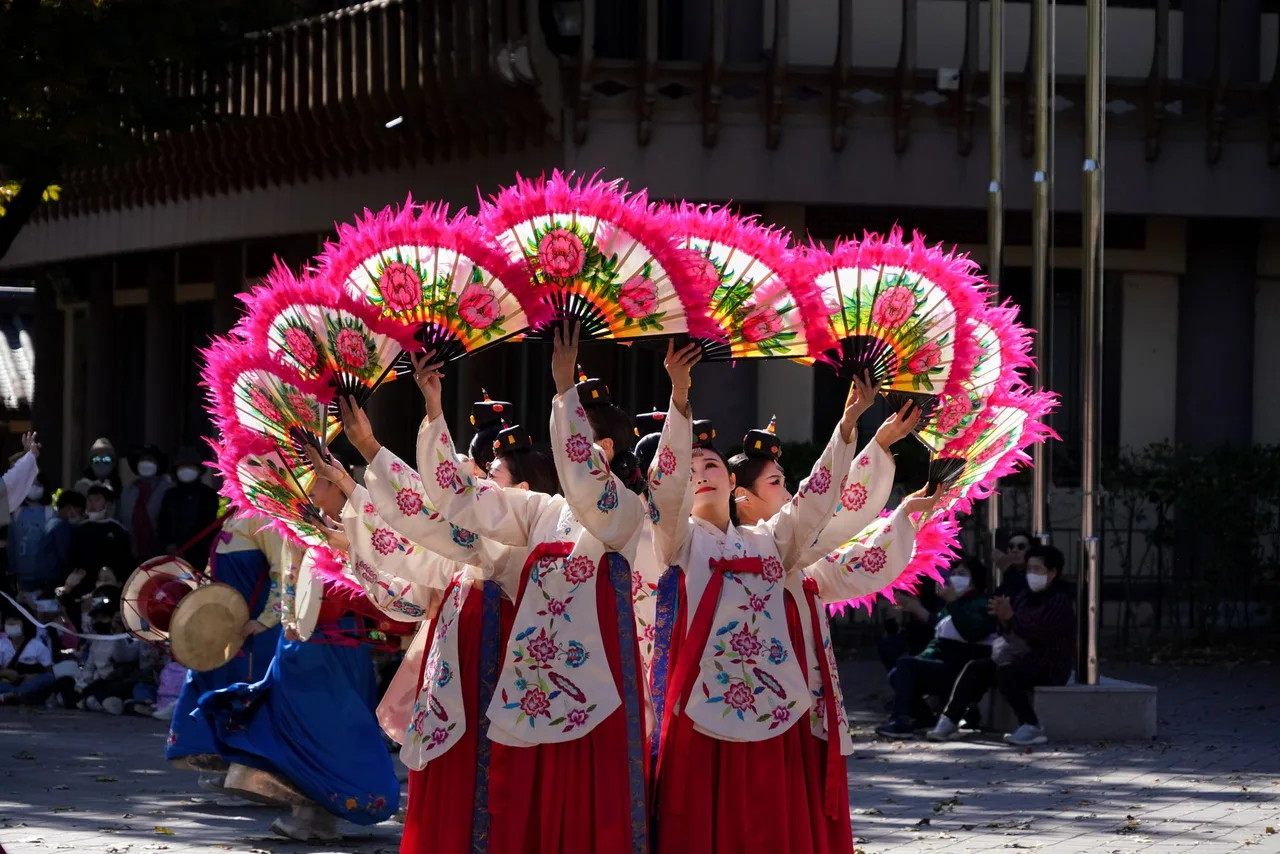
A buchaechum begins with the dancers hidden behind their fans. Then the pink peony petals painted across the silk swing open in one long sweep, and the line of performers turns the stage into a slow, rippling wave of color. That single image says a lot about Korean traditional dance. It rarely hurries. It builds feeling through breath, posture, and the unhurried curve of an arm before the movement releases into something larger.
For a first-time viewer, the names arrive fast: jeongjae, minsok chum, talchum, salpuri, seungmu. Each one carries its own mood and its own reason for existing. Some were made for kings and performed inside palace walls. Others grew out of harvest festivals, Buddhist temples, and shaman ceremonies held to comfort the living and settle the dead. Knowing which is which turns a pretty performance into a story you can actually follow.
Court dance versus folk dance
The clearest way to sort Korean dance is by where it was born. Court dances, called jeongjae (정재), were staged inside royal palaces for the king, the queen, and foreign envoys. Everything about them signals order. The tempo is slow, the lines are symmetrical, and nearly every gesture stands for something. Cheoyongmu, one of the oldest surviving court dances, dates back to the Unified Silla period and was inscribed by UNESCO in 2009. Five dancers in white, blue, black, red, and yellow costumes move to drive away evil spirits, one color for each direction of the compass. Chunaengjeon, the "spring nightingale" dance, is quieter still: a single dancer performs on a small flower-patterned mat, imitating a bird greeting the season.
Folk dances, or minsok chum (민속춤), came from the opposite end of society. Farmers, villagers, and traveling entertainers made them, and the mood is warmer and looser. Ganggangsullae, a women's circle dance once tied to the harvest moon, has performers link hands and spin faster and faster until the ring nearly breaks. If court dance is about holding a shape, folk dance is about releasing energy. Many folk forms were danced in open courtyards where the audience stood close enough to shout back. The palaces where court dance once lived are still standing, and you can read more about them in our guide to Seoul's five grand palaces.
Buchaechum, the fan dance
The buchaechum (부채춤) is probably the image most people picture when they think of Korean dance, all bright hanbok and blooming fans. It also happens to be one of the youngest forms here. The dancer and choreographer Kim Baek-bong created it in 1954, drawing on older court and shaman movements but shaping them into something new for the modern stage. So while it feels ancient, it is closer in age to the pop songs of the 1950s than to the Joseon court.
The fans do the storytelling. Each one is painted with pink peony blossoms, and as groups of dancers raise, lower, and overlap them, the shapes read as waves, butterflies, opening flowers, and birds in flight. A single fan is a small gesture. Thirty fans moving together become a landscape. The dancers wear brightly colored hanbok that widen the silhouette, so the whole group reads as one shifting pattern rather than a set of individuals.
Buchaechum also travels well, which is part of why foreigners tend to meet it first. A Korean troupe performed it at the 1968 Mexico City Olympics, and it has been a fixture of cultural showcases abroad ever since. The accompaniment is usually a folk song or an instrumental sanjo, light enough to let your eyes lead the way. If you see only one Korean dance on a short trip, this is the one you are most likely to catch.
Talchum, the mask dance drama
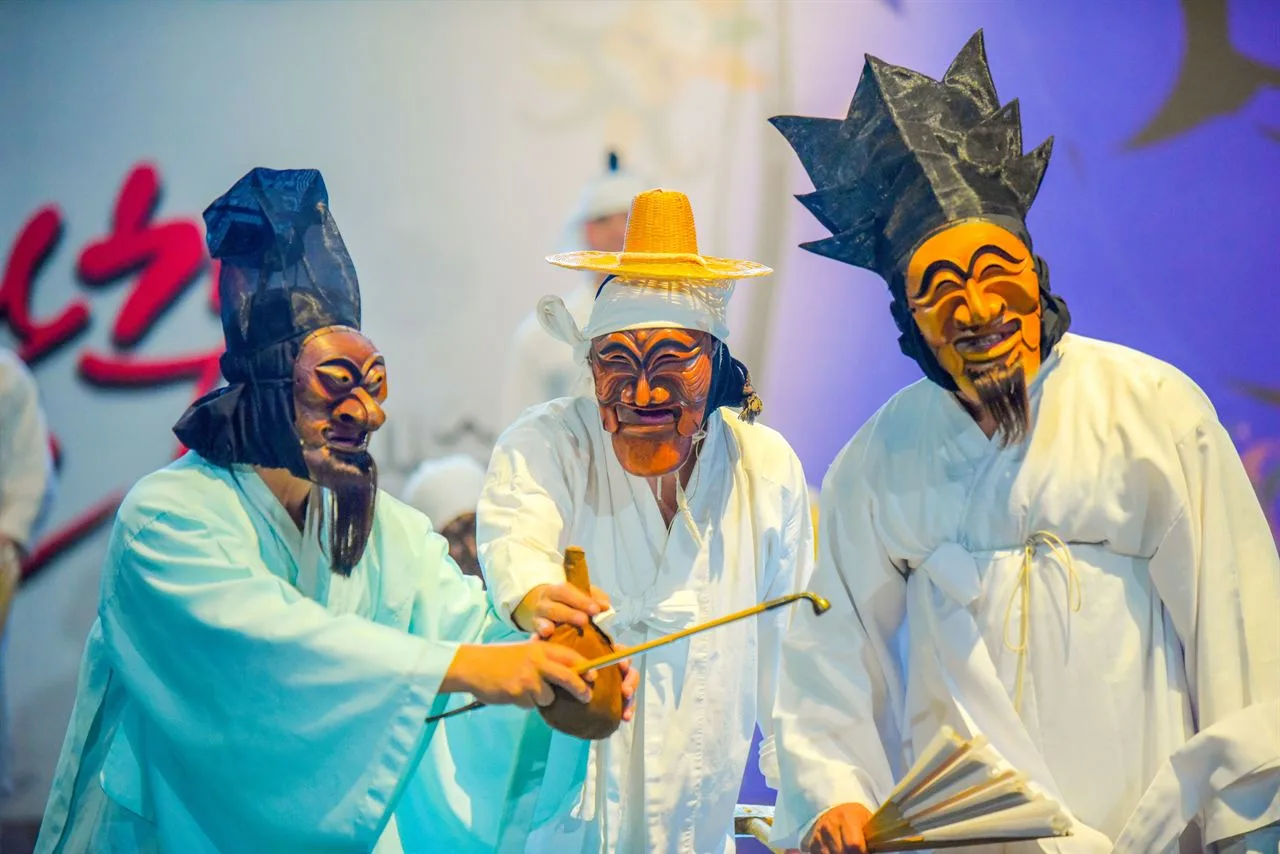
Talchum (탈춤) joins two plain words: tal, meaning mask, and chum, meaning dance. In practice it sits closer to street theater than to pure dance. A small band of six to ten musicians plays while masked performers sing, joke, argue, and dance their way through a loose story. UNESCO added talchum to its Representative List of Intangible Cultural Heritage in 2022, recognizing it as Korea's twenty-second entry on that list.
What made talchum matter was its bite. The masks let ordinary villagers mock the people above them: pompous aristocrats, corrupt Buddhist monks, know-it-all scholars, unfaithful husbands. Behind a carved wooden face, a performer could say things that would have been dangerous in daily life, and the crowd loved it. The humor ran broad and physical, but the target was real social power. That habit of talking back through art connects talchum to other Korean storytelling forms, including the sung drama described in our piece on what pansori is.
Regional versions each have their own flavor. Bongsan talchum, from Hwanghae Province in what is now North Korea, runs through seven acts full of broad comedy. The Hahoe byeolsingut talnori, from the village of Hahoe near Andong, began as a ritual performed to please the village guardian god and still carries that ceremonial weight. Watching one is loud and funny, and often surprisingly modern in its complaints.
Salpuri, a dance that lets sorrow go
Salpuri (살풀이) is where Korean dance turns inward. The name means roughly "to cleanse away misfortune," and the form grew out of shaman rituals meant to release grief and bad energy. A single woman dances alone, dressed entirely in white, holding one long white silk scarf. For long stretches almost nothing seems to happen. She shifts her weight, breathes, lets the scarf hang. Then, without warning, the cloth swirls up and snaps through the air before drifting slowly down again.
That restraint is the whole point. Salpuri tries to give shape to han, the hard-to-translate Korean feeling of accumulated sorrow and unresolved longing. Because so much has to be expressed through so little motion, dancers regard it as one of the most demanding pieces in the repertoire. The Korean government recognizes it as Important Intangible Cultural Property No. 97, and its finest performers spend decades refining the timing of a single throw of the scarf. If buchaechum is built to delight a crowd, salpuri asks the audience to sit still and feel something quieter. Seeing it live, in a room where you can hear the drum breathe between beats, is a very different experience from watching a clip online.
Seungmu, the monk's dance
Seungmu (승무) is often named by Korean dancers themselves as the most beautiful piece in the tradition, and it is easy to see why. The soloist wears a white robe called a jangsam with sleeves so long they trail well past the hands, plus a peaked white hood, the gokkal, associated with Buddhist monks. For much of the dance the performer seems to wrestle with those enormous sleeves, throwing them into the air and letting them fall in slow arcs that never quite settle.
The story underneath is a spiritual one. Seungmu is usually read as the inner struggle of a monk caught between worldly desire and religious discipline. The tension builds quietly until the dancer reaches a large drum and begins to strike it, faster and faster, the rhythm finally breaking the stillness that came before. That drum climax is the moment audiences wait for. Korea designated seungmu as Important Intangible Cultural Property No. 27 in 1969, protecting both the choreography and the specific drumming that goes with it. Despite the Buddhist costume, the dance is performed on concert stages rather than in temples, and no religious training is required to appreciate it. Watch the sleeves first. They carry almost all of the emotion.
Sword dances, drum dances, and other forms
Beyond the headline pieces, Korean dance holds a deep bench of specialized forms. Geommu (검무), the sword dance, began as a martial display and softened over the centuries into something graceful. Dancers handle short swords with loose, rotating blades that flash and rattle as the wrists turn, blending the memory of combat with flowing sleeve work. The version preserved in the city of Jinju is one of the best known and is protected as a national cultural property.
Taepyeongmu, the "dance of great peace," is prized for its intricate footwork, with quick, precise steps that dancers train for years to master. Then there is the world of percussion dance. Nongak, the farmers' music tradition, fills a field with drummers and gong players, some of them spinning long white ribbons attached to their hats in wide overhead loops. Its tighter stage cousin, samulnori, drives four percussion instruments into fast, interlocking rhythms that pull the dancers along. Mugo and other drum dances turn the instrument itself into the centerpiece, with performers circling a large barrel drum and striking it in turn.
None of these are museum pieces. Percussion troupes still play at festivals, temple events, and street celebrations, and the sword and drum dances appear regularly on the same stages as buchaechum and seungmu. Together they show how wide the tradition runs, from courtly restraint to full-throated village noise.
The music and costume that carry the dance
You cannot really separate Korean dance from the music beneath it. Nearly every form is built on jangdan, the repeating rhythmic cycles played on the hourglass-shaped janggu drum. A slow jangdan asks for long, suspended movement; a fast one lets the dancer cut loose. Around that drum sit the other core gugak instruments: the piercing piri oboe, the breathy daegeum flute, and the plucked gayageum zither. The dancer listens for the drum's accent and answers it with the body, so the two are really in conversation. If you want to understand what the musicians are doing, our overview of traditional Korean music breaks down the instruments and rhythms.
Costume does similar work for the eyes. The hanbok used in dance is cut fuller and longer than everyday wear, with high waistlines and wide sleeves that keep moving after the dancer stops. Color is deliberate. The five traditional colors, tied to the five directions and elements, show up again and again, which is why cheoyongmu dancers split into white, blue, black, red, and yellow. Props extend the line of the body: a fan stretches a gesture into a wave, a long white scarf turns a breath into a visible arc, a sword adds a glint of danger. Once you start watching how cloth and prop finish each movement, the choreography reads much more clearly.
Where to see Korean traditional dance
The best place to start is the National Gugak Center in the Seocho district of Seoul, the country's main institution for traditional performing arts. It runs regular programs, including weekend concerts that pair court music with dance, and tickets are usually modest. Because the same organization trains and preserves many of these forms, the standard stays high and the staging is faithful.
For something built around visitors, Jeongdong Theater sits near Deoksugung Palace in central Seoul and stages traditional productions such as its long-running "Miso" show, which strings several dances together into a light seasonal story. Korea House, near Namsan, pairs a performance with a Korean meal, which makes for an easy first outing. Outside the city, the Korean Folk Village in Yongin puts on outdoor farmers' dance and rope-walking during the day in a recreated old village setting, and the palaces sometimes host court dance around the Lunar New Year and Chuseok holidays. Exact schedules shift by season, so check each venue's own calendar before you go.
A few habits help. Book ahead for popular shows, arrive early enough to read the program notes, and check whether photography is allowed, since many stages ask you to put the phone away. A little theater etiquette goes a long way, and our guide to Korean etiquette covers the basics. Come for the costumes if you like. You will probably leave thinking about the silence between the drumbeats.
Frequently asked questions
What are the main types of Korean traditional dance?
The two broad families are court dance (jeongjae), created for royal ceremonies, and folk dance (minsok chum), which grew out of villages and rituals. Well-known individual forms include the fan dance buchaechum, the mask dance drama talchum, the shamanic salpuri, and the monk's dance seungmu.
Is Korean mask dance (talchum) recognized by UNESCO?
Yes. UNESCO inscribed talchum on its Representative List of the Intangible Cultural Heritage of Humanity in 2022. It combines dance, music, and theater, and uses masked characters to satirize social hierarchy.
What is the difference between salpuri and seungmu?
Salpuri is a solo dance in white with a long silk scarf that grew from shaman cleansing rituals and expresses sorrow, or han. Seungmu is the monk's dance, performed in a long-sleeved robe and hood and building to a drum climax. Both are protected as Important Intangible Cultural Properties (No. 97 and No. 27).
Where can I watch Korean traditional dance in Seoul?
The National Gugak Center in Seocho is the main venue, with regular weekend programs. Jeongdong Theater near Deoksugung Palace and Korea House near Namsan also stage traditional dance for visitors, and the Korean Folk Village in Yongin shows outdoor farmers' dance.
What is buchaechum, the Korean fan dance?
Buchaechum is a group fan dance choreographed by Kim Baek-bong in 1954. Dancers in bright hanbok move large peony-painted fans to form shapes like waves, flowers, and butterflies. It is one of the most internationally recognized Korean dances.
Sources
This guide was researched using the references below. Prices and times change, so confirm anything time-sensitive on the official page before you rely on it.
Related guides
- Where to buy Korean pottery: a guide for foreignersDiscover where to purchase authentic Korean pottery, from traditional markets in Seoul to renowned ceramic towns, and learn about the rich history behind t
- Exploring traditional Korean art stylesAn in-depth look at traditional Korean art styles, including painting, ceramics, and crafts, highlighting their history and cultural significance.
- What is minhwa, Korean folk painting?Minhwa, meaning 'painting of the people,' is Korean folk art created by anonymous artists to depict everyday life and convey symbolic meanings.
- Korean tea culture and where to experience itA visitor's guide to Korean tea, from Boseong's green tea fields and the darye ceremony to jujube and citron brews and where to drink it in Seoul.
- Korean traditional music (gugak) and where to hear itWhere to hear Korean traditional music in Seoul, from the National Gugak Center's Saturday concerts to Jongmyo rite music, plus what the sounds mean.
- Where to try Korean crafts: pottery, calligraphy and hanjiTry Korean pottery, calligraphy and hanji papermaking in Insadong, Icheon and Jeonju, with real prices, subway routes and how to book.